
by Nikki Toxopeus
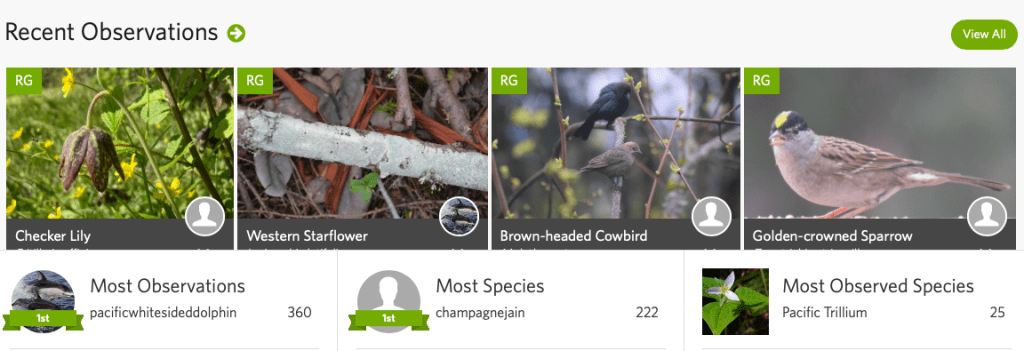
The results are in, the stats are done, and the prizes awarded!

The Yellow Point Ecological Society BioBlitz for 2023 is officially over! Thank you to all our participants and identifiers for making it so much fun and so successful.
We clocked up a similar number of species as previous years, with fewer observers. We had 298 research grade species as shown below, thanks to the quality of the observations and the support of the wider iNaturalist community helping ID the entries.
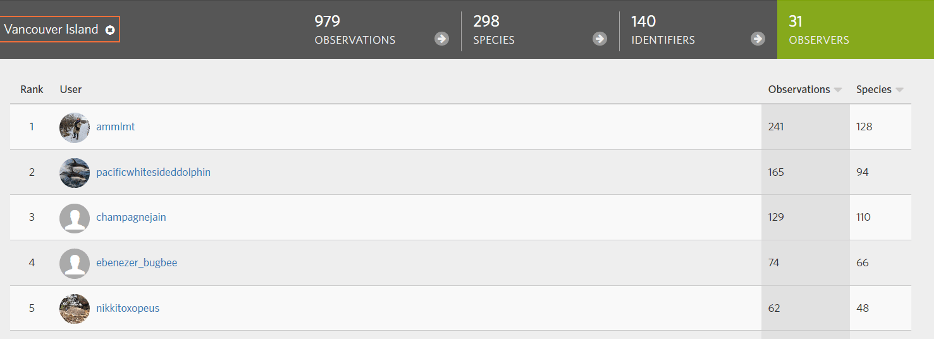
YES board members are not eligible for prizes, and so our prize winners are Annette Lefaivre (visiting from Calgary and helped map the area), Liam Steele (from Ladysmith and an outstanding young naturalist) and Heath Bleau (who recently moved, with his wife Kathy, to Nanaimo). Annette and Heath received a set of 10 Briony Penn Nature cards, and Liam was persuaded to accept a BC Museum Mushroom book, in part as a thank you for all his work helping to ID species.
We also awarded a school prize to the Grade 3 class at the Stz’Uminus Community School, who joined the BioBlitz for the first time and will be presented with a set of the Pacific North West Plant Knowledge Cards and a set of Briony Penn’s Nature posters.
Our results compared to last two years (given in brackets) are as follows:
Observations 1847 (2004, 2289)
Species 538 (556, 508)
Identifiers 165 (178, 252)
Observers 38 (47, 62)
This year, the most observed species were
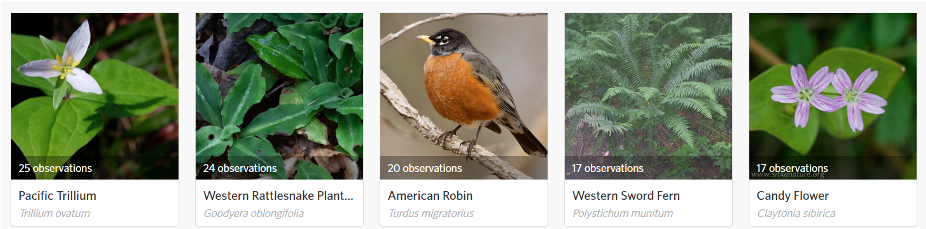
Pacific Trillium (Trillium ovatum) was the most observed and by the most people.
Western Rattlesnake Plantain (Goodyera oblongifolia) was spotted multiple times by a few people.
The Great Blue Heron (Ardea herodias) was the top observed species last year and no one recorded it this year.
Other notable differences were that there were only 4 sightings of the Bald Eagle (Haliaeetus leucocephalus), Devil’s club (Oplopanax horridus) was absent this year, and western meadow rue (Thalictrum occidentale) was seldom seen.
The most observed species aligns with my experience of this season – the trilliums were out in force, the robins were furiously nesting and dominating the dawn chorus, and I did not see the Great Blue Heron by the Ladysmith Marina (but they are back now).
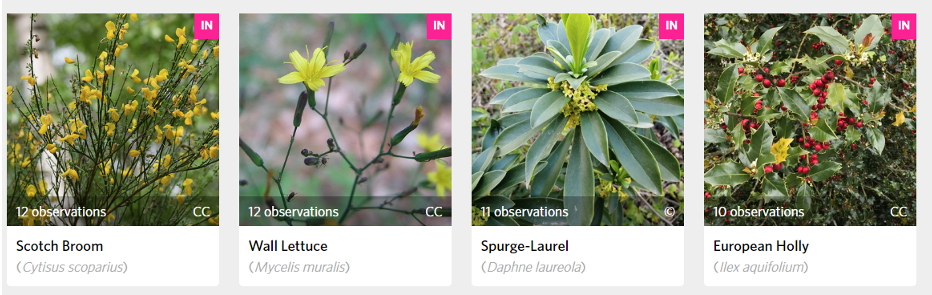
The top introduced and invasive species recorded remain:
Scotch Broom (Cytisus scoparius) – located along Cable Bay Trail, in Joan point Park, Holland Creek Park, Holland Creek Estuary Trail, Haslam Creek, near yellow Point Lodge and along power line ROWs. Broom cuts are planned for some of these locations.
European Holly (Ilex aquifolium) – located in Stocking Creek Park, Holland Creek Park, Morden Colliery, Kinsman Park, Estuary Trail, and other roadsides
Spurge-laurel (Daphne laureola) – all the above parks!!
I will be using and adding to this data set to help determine where we need to remove invasives from our parks and other special areas.
There was some great teaching and learning happening in the online chatter. Next year let’s expand the learning to the field, organise some group walks and take the iNater chatter to the field.
See you same time, same place next year! Reserve April 26-29th 2024 for getting out in nature with your friends, family, and other naturalists. This date aligns with the global City Nature Challenge BioBlitz and we hope Nanaimo and other Vancouver Island Cities will join in again.
Many thanks! – Nikki Toxopeus

 Yellow Point Ecological Society