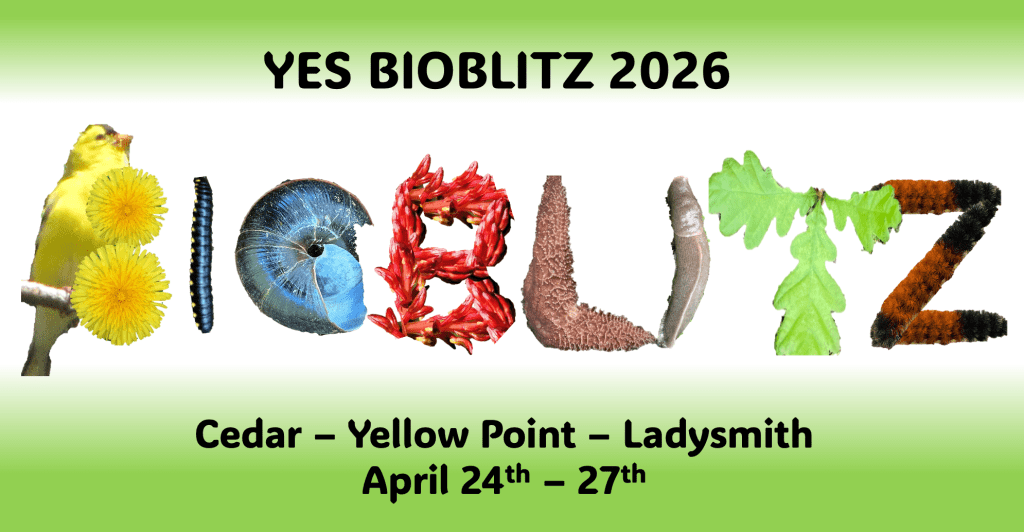
You can sign up here YESBioBlitz2026 under the community menu.
(When you are logged-in to iNaturalist. )
Why join?
This is a valuable community science event which collects data, which supports research and policy maker to protect our environment. Check out how your data makes a difference here. It is also a great opportunity to develop a local community of people who understand and care for the environment.
There are many strange facts about beavers that we Canadians should know just … because. No one has probably seen a nickel lately, but the nation’s animal has graced the coin since 1937.
Source: OpentextBC
Beavers are known mostly for their logging expertise. They can fell a 5” diameter tree in three minutes according to Frontenac News.
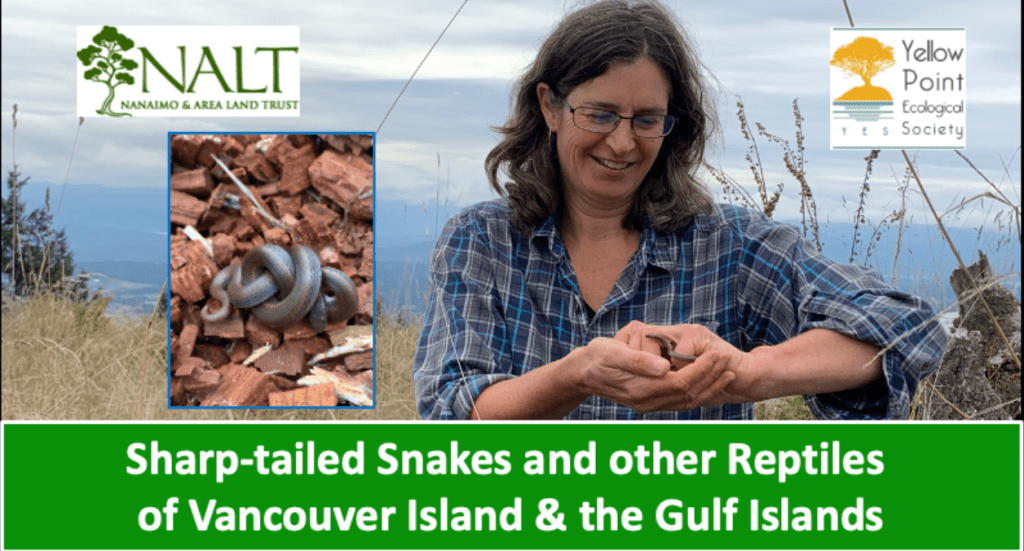
Here is the video from Carrina Maslovat’s and Laura Matthias’ presentation https://youtu.be/H7_HeeEQlLE. If you have an area of sun-filled Garry oak meadow on your land, and are interested to set up artificial cover object (black asphalt shingle) to observe if you have these tiny snakes (see below) on your land, please contact Linda Brooymans at the Nanaimo area Land Trust. stewardship@nalt.bc.ca The video explains all about it.
A smart phone or camera to capture images or sounds.
A smart phone or computer to upload your images or sounds.
You can use the iNaturalist App or the webpage iNaturalist.ca.
Where to go?
The area for this year’s YES Bioblitz is the same as 2024. It includes Ladysmith, South Nanaimo, Cassidy, and our coastal waters to the east – see map below. There are many public parks where you can explore, and there are reserves and private lands where you need permission. NOTE: We do not have permission to enter the Woodley Range Ecological Reserve.
Only photos and sound recordings taken during the designated dates and times (6am on April 25th to 8pm on April 28th) in this geographical location will count towards our YES BioBlitz. Of course, everything entered in iNaturalist, year-round and in other places, is still valuable.
How?
Check out the resources and links below and note the top tips:
Take good pictures – focus properly, fill the frame or crop the picture, take different views.
Fill the gaps in local knowledge – go to places or look for species others tend to overlook.
Make your data shareable – make sure the location is recorded, and check that your license settings allows the data to be used. iNaturalist recommends using CC0, CC BY or CC BY-NC. Licenses are located under the account settings, in contents and display.
Participate as a school group
There are many great resources on iNaturalist and the Internet on how to participate as a school group, how to take photos that can be identified, and how to use iNaturalist. In some cases you should use Seek, which is a simpler app with more privacy controls, just as educational.
If you have questions, message us in iNaturalist or email us at yesbioblitz@gmail.com. If you want to chat, let us have your phone number and we will call back.
One winter afternoon in 2021, after a big winter storm, Carolyn and I were enjoying some time off at Cowichan Bay. As we strolled down the dock, expecting to see the sea-lions, we saw instead something that astonished us. The entire sea had turned brown – murky brown. The sea-lions had fled, along with any transient sailors. The fish and ducks had surely fled too. “It happens every year”, we were told.
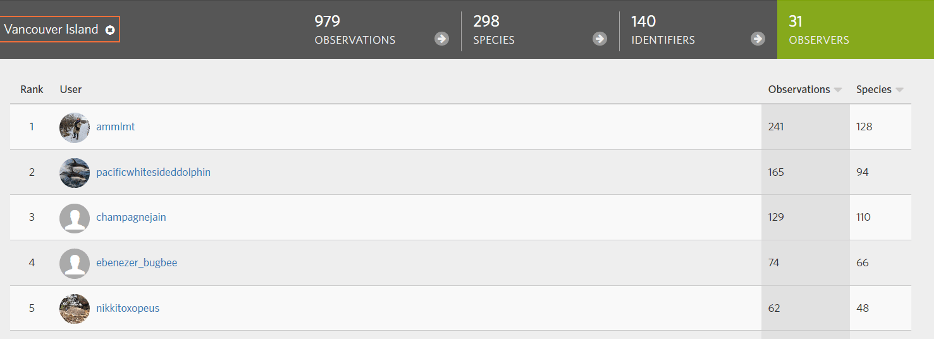
We clocked up a similar number of species as previous years, with fewer observers. We had 298 research grade species as shown below, thanks to the quality of the observations and the support of the wider iNaturalist community helping ID the entries.
YES board members are not eligible for prizes, and so our prize winners are Annette Lefaivre (visiting from Calgary and helped map the area), Liam Steele (from Ladysmith and an outstanding young naturalist) and Heath Bleau (who recently moved, with his wife Kathy, to Nanaimo). Annette and Heath received a set of 10 Briony Penn Nature cards, and Liam was persuaded to accept a BC Museum Mushroom book, in part as a thank you for all his work helping to ID species.
We also awarded a school prize to the Grade 3 class at the Stz’Uminus Community School, who joined the BioBlitz for the first time and will be presented with a set of the Pacific North West Plant Knowledge Cards and a set of Briony Penn’s Nature posters.
Our results compared to last two years (given in brackets) are as follows:
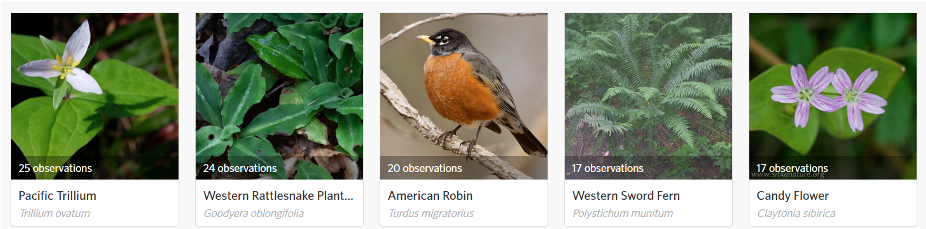
Pacific Trillium (Trillium ovatum) was the most observed and by the most people. Western Rattlesnake Plantain (Goodyera oblongifolia) was spotted multiple times by a few people. The Great Blue Heron (Ardea herodias) was the top observed species last year and no one recorded it this year.
Other notable differences were that there were only 4 sightings of the Bald Eagle (Haliaeetus leucocephalus), Devil’s club (Oplopanax horridus) was absent this year, and western meadow rue (Thalictrum occidentale) was seldom seen.
The most observed species aligns with my experience of this season – the trilliums were out in force, the robins were furiously nesting and dominating the dawn chorus, and I did not see the Great Blue Heron by the Ladysmith Marina (but they are back now).
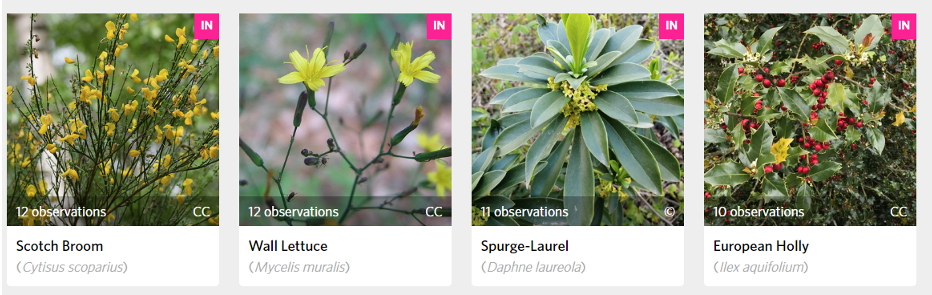
The top introduced and invasive species recorded remain: Scotch Broom (Cytisus scoparius) – located along Cable Bay Trail, in Joan point Park, Holland Creek Park, Holland Creek Estuary Trail, Haslam Creek, near yellow Point Lodge and along power line ROWs. Broom cuts are planned for some of these locations. European Holly (Ilex aquifolium) – located in Stocking Creek Park, Holland Creek Park, Morden Colliery, Kinsman Park, Estuary Trail, and other roadsides Spurge-laurel (Daphne laureola) – all the above parks!!
I will be using and adding to this data set to help determine where we need to remove invasives from our parks and other special areas.
There was some great teaching and learning happening in the online chatter. Next year let’s expand the learning to the field, organise some group walks and take the iNater chatter to the field.
See you same time, same place next year! Reserve April 26-29th 2024 for getting out in nature with your friends, family, and other naturalists. This date aligns with the global City Nature Challenge BioBlitz and we hope Nanaimo and other Vancouver Island Cities will join in again.
No Mow May is fun and a lazy way to start the summer and is a fantastic way to help the birds and the bees. It is also something we all have the skills to do and it will really help all the wildlife that depends on the creatures and plants in our gardens, meadows, and roadside ditches. If we delay mowing until after the end of May, we may be surprised how quickly Nature responds. So, is there a patch you can protect?
Spring is the season of breeding and feeding young. Birds need their nests undisturbed, and they need bugs and caterpillars to feed their young for a few weeks. Bird feeders do not cut it for the baby birds. There used to be a lot more food for the birds but insects are in decline. Remember when there were many more bugs? All over our windshields?
Fun facts
Chickadees need to feed their chicks about 500 caterpillars a day for at least two weeks. This can be more than 10,000 caterpillars.
Land based insects are disappearing at a rate of 1% per year, due to the loss and fragmentation of their habitat.
Globally, pollinator services are worth more than $200 billion a year.
35% of our food depends on pollinators.
The Yellow Point Ecological Society supports the vision of the Canadian Wildlife Federation and Nature Conservancy of Canada to build a network of interconnected wild yards, hedgerows, fields, rights of way and roadsides that can be left undisturbed during the spring breeding season (and the fall too!).
If we can make our backyards more pollinator friendly and chat to our neighbours to get them on board with our “new look”, we can have a big impact. Citizen science done by the British organization Plantlife shows that the simple act of No Mow May can increase the number of bees in your yard tenfold. Doug Tallamy’s book Nature’s Best Hope gives wonderful advice on the native species we should plant to turn our back yards into refuges for wildlife. There is a growing body of knowledge and native plant supplies on Vancouver Island. The Nanaimo Area Land Trust has started a Pollinators Paradise project, to promote the use of native pollinator-friendly plants and other ways to support pollinators. They are launching their project web page this month – so watch this space.
The Ministry of Transportation is also part of the solution. They are responsible for keeping the vegetation within 1.8 m of the road below 25 cm high, for traffic safety. In May, the Contractors are usually busy cleaning up the gravel and controlling the dust along the roadsides and do not start mowing until June. They delay mowing so they only mow once a season (and save the taxpayers’ money). Often, they cannot mow for most of the summer due to fire hazards, so the vegetation is brushed or mowed in August or September. If rights of way were planted with low, resilient shrubs and herbaceous native plants which do not need mowing, this might also keep invasive species from dominating. The Contractor I spoke to said he had worked in areas with healthy ecosystems, where the native vegetation grew in the rights of way and kept the invasive species away. Invasive plant species do not suit native wildlife but that is a topic for another day.
For now, it would be great to grow the support for No Mow May. It is an easy way to help protect wildlife and their habitats during the sensitive breeding season. If we must mow, we should mow as high as possible. It will be better for the lawn, and the ground dwelling bees. Perhaps we can create refuges in spaces away from the lawn. In this way we can mitigate the biodiversity crisis and save our money, time, and energy.






 Yellow Point Ecological Society