Blog

Featured

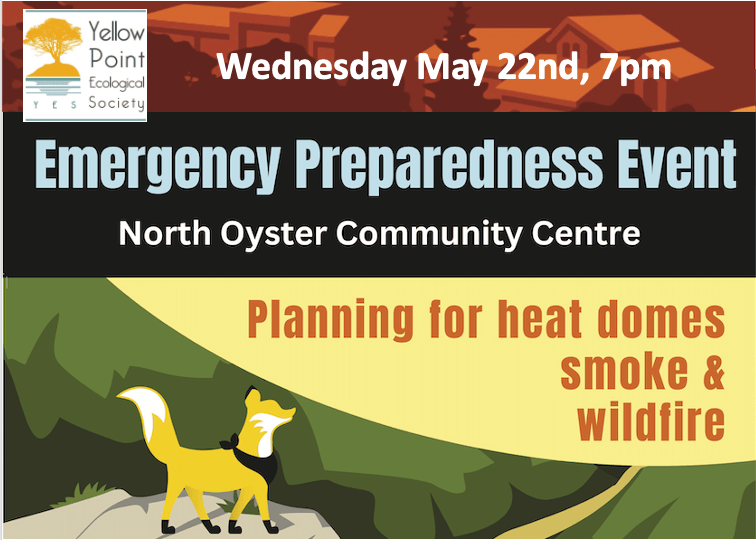
Planning for Heat, Smoke and Wildfire

Wednesday May 22nd, 7pm, at North Oyster Community Hall

Join us for a workshop with Todd Carnahan,  and Dr. Angela Eykelbosh to learn how our community can prepare for heat domes, smoke and wildfire threats.  Presentations will touch on emergency planning, hazard mitigation, and evacuation alerts for our area.  Their presentations will be followed by a Q&A.

Todd Carnahan is a FireSmart representative with Emergency Management Cowichan (EMC). He is also a conservation photographer and biologist focused on the nature of Vancouver Island and the Salish Sea. https://www.toddcarnahan.com  

Dr. Angela Eykelbosh is an environmental health scientist and knowledge translation specialist with VIHA.

Firesmart Home Assessments are a free and confidential service provided by EMC. Qualified homeowners may be eligible for grants of up to $1000. We will learn how to create an inexpensive air filter for wildfire smoke in the home, and how to beat the summer heat. 

Free. In person. Not on Zoom!

Featured

The Ups and Downs of Falling Leaves 

By Pamela Walker and Carolyn Herriot 

Published in TAKE 5 Magazine, October 2021

Soil, on which all life outside the ocean depends, has been created in part by thousands of years of falling leaves. As they fall down, life rises up. It’s the perennial gift that keeps on giving, but a resource that is often overlooked. After a year of drought we should all be stockpiling leaves to use as a protective mulch for next year’s garden. Broken down leaf mould can hold 300 to 500% of its weight in water. Rich topsoil, by comparison, holds about 60%. Leaf mulch holds in moisture, adds organic matter to the soil and provides nutrients to plants. It’s as precious as bullion to plants and beneficial insects, so whatever you do, don’t burn leaves or throw them away in a large plastic bag! 

Continue readingThe Ups and Downs of Falling Leaves 
Featured

YES BioBlitz 2021 – It’s Over!

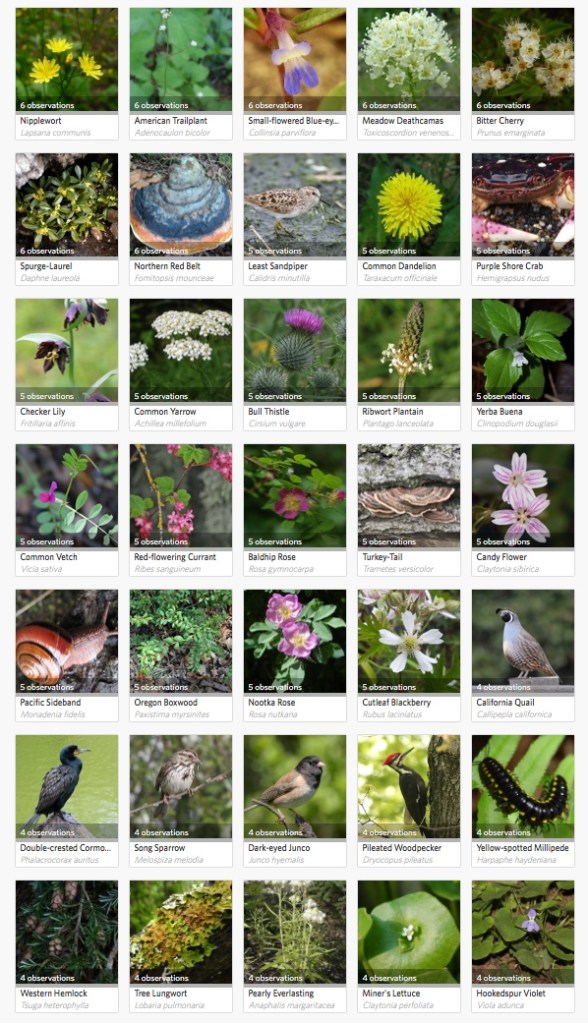
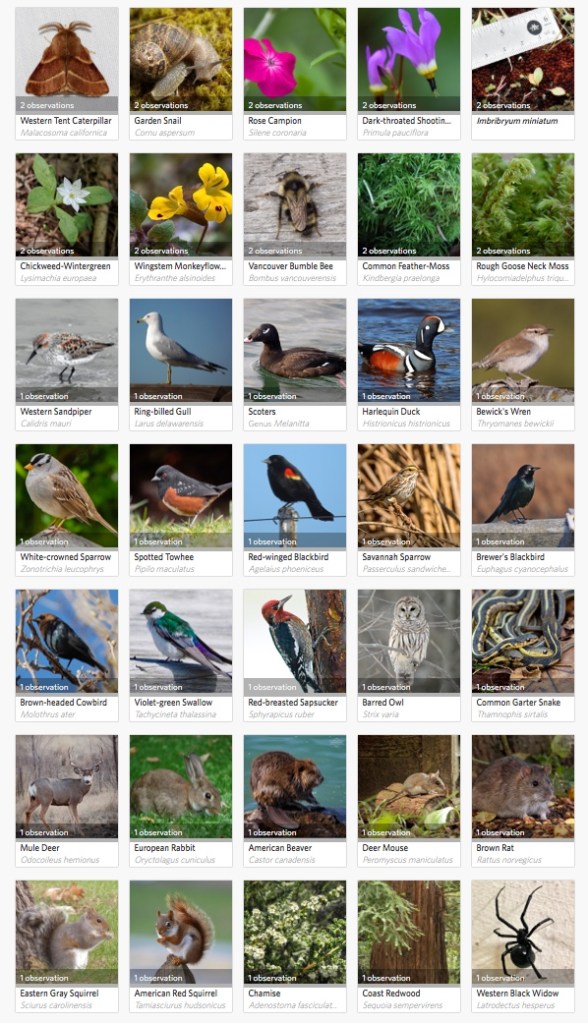
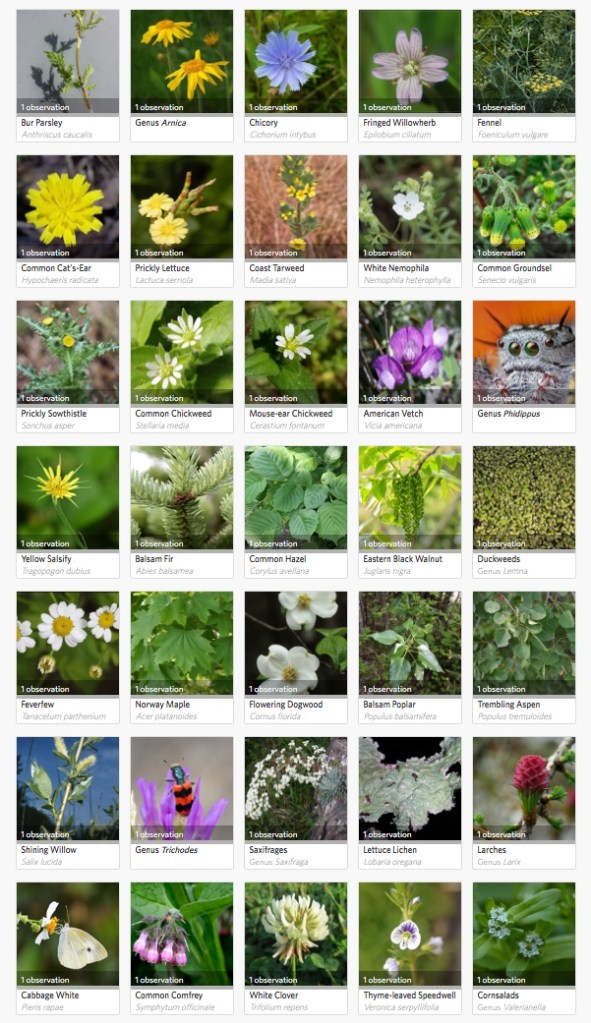
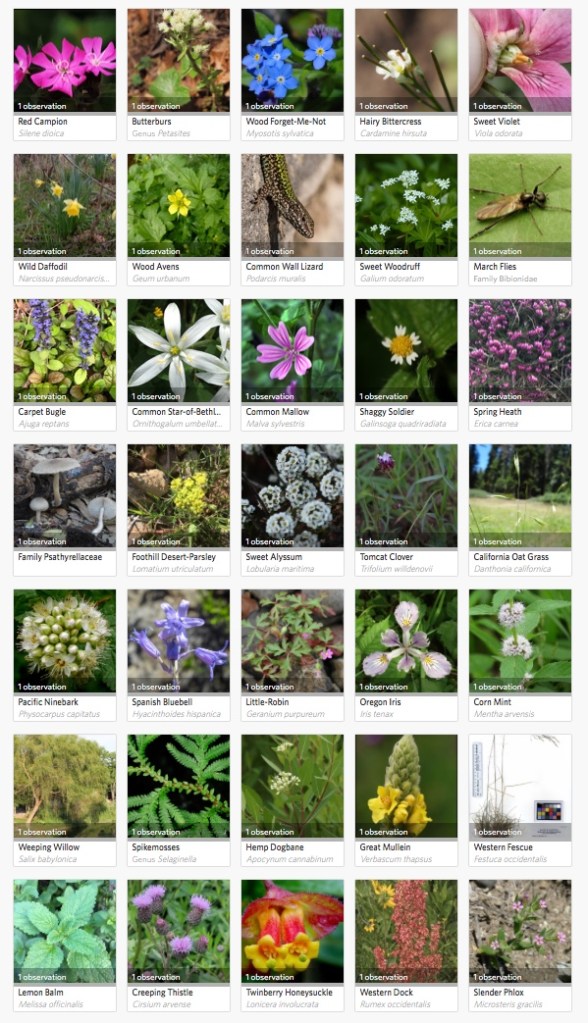
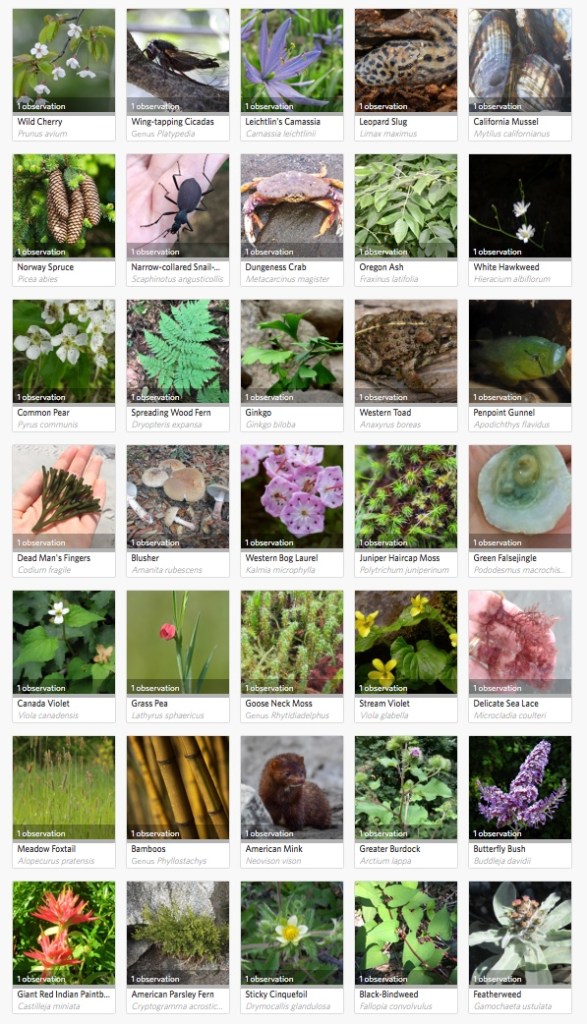
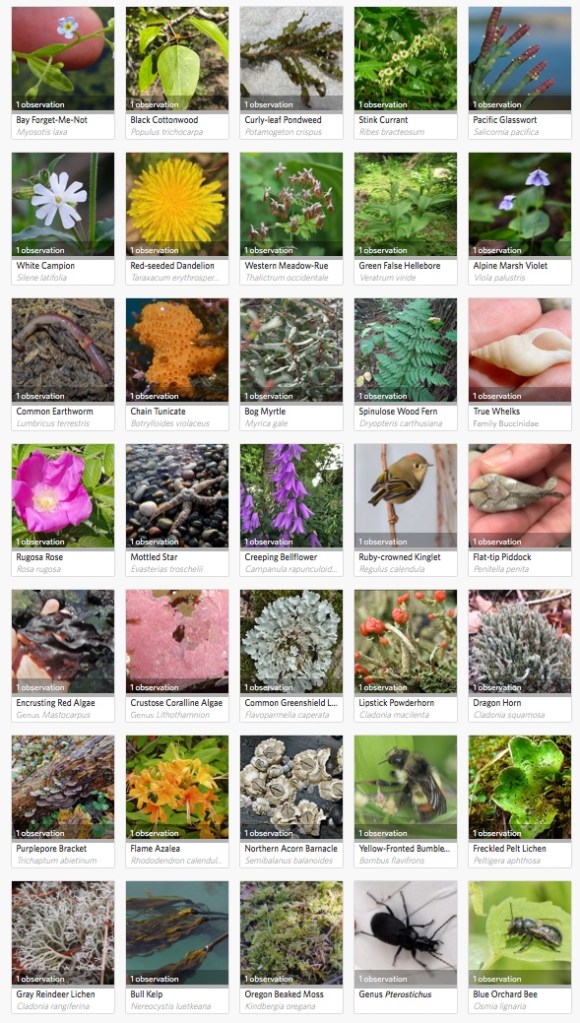
Our BioBlitz is over, at least for this year! To see all 533 different species that were identified, see below, or click here.

We would like to celebrate our book prize winners and all the participants who made the event so much fun and such a great success. Nikki would especially like to thank Carrie Robinson who organized the event and made it more fun by adding the book prizes. They are such great BC wildlife books and everyone did such great work.  They were awarded to the following:

  • Liam Steele, Plants of Coastal British Columbia
  • Greg Roberts, Amphibians of Oregon, Washington and British Columbia
  • Coco van Zyl, Birds of South Western British Columbia
  • North Oyster School, The Mammals of British Columbia
  • Sense of Place, The Mammals of British Columbia

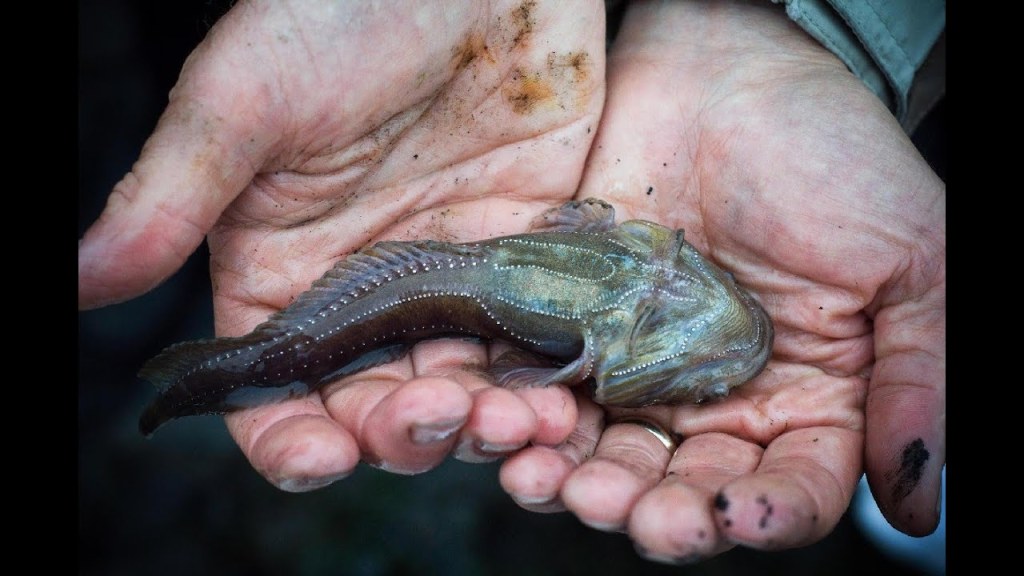
Liam Steele, age 11, is clearly an I-Naturalist super-user and worth following on I-Naturalist under Pacificwhitesideddolphin.We were so fortunate to have him join our event. Not only did he have the top number of observations; he also ID’d over a hundred species for other participants and had some amazing shots, like the Plainfin Midshipman (the fish that sings) and the American Mink (by Transfer Beach). He started his career as an i-Naturalist in June 2019 at the age of 9, when he used it as a guide for listing species on his summer vacation in Vernon and Osoyoos. He was 10 ¾ before he knew he could join i-Naturalist and he has now made over ten thousand observations. We are sure he will achieve his goal of becoming a wildlife biologist, and hope he finds the Pojar and MacKinnon Plant book useful in this quest. 

Greg Roberts, unlike Liam, started with the Pojar and MacKinnon Plant book and he has been using it for years. Through our YES BioBlitz he has just been introduced to i-Naturalist. He was one of our most enthusiastic participants. He was there at the meeting asking the tough questions and was the first one onto the field on Day 1 of the BioBlitz.  Greg has accumulated a lifetime of great wildlife pictures from his career as a trained geographer who spent most of his working life behind a desk in park and land planning but most of his free time canoeing, camping, and exploring. He has now started to upload his images into i-Naturalist and is really enjoying the help the app gives with IDs.

Coco van Zyl knows every inch of the land she has been stewarding for the past six years.  She has repeatedly removed invasive and non-native species, encouraging and protecting native plants until they are robust enough to thrive. We are so lucky to have her record some of these species and to ID species for others. She needs little help from I-Naturalist to ID plants, and could probably help improve their App in this area.

Desiree Ferdinandi signed up North Oyster School for the BioBlitz and worked with her colleagues, Camille Paradis and Heather Trawick, and students in Grades 2, 3 and 6/7 to participate. They organized classes so that students took pictures and the grade 6/7 class uploaded them to her i-Naturalist account. She spent the week trying to ID them. Desiree is quick to point out that Camille Paradis and Heather Trawick put a lot of time and effort into getting North Oyster involved in the BioBlitz and did the lion’s share of the organizing. The end results were very respectable, and it was great fun for all. We would love to invite Desiree, Camille and Heather to our BioBlitz meeting next year to share how schools and groups can collate their observations. 

Patti Gisborne signed up the Sense of Place Youth Project Outdoor Explorers. Amanda McDonough, their outdoor exploration manager, said they “were thrilled to photograph and record the diversity of life on the Gisborne property. The children learn about the plants and creatures here seasonally, and they found great joy in sharing that data in the BioBlitz. Children took turns discovering and photographing their favourite plants throughout the forest, field, orchard, and pond. They loved being able to identify unknown species through the i-Naturalist app. We will definitely be utilizing this app in the future for our programming!“

YES plans to host the BioBlitz as a regular annual event, and we are keen to hear suggestions on how we can make it even better next year. Please email us or post comments on our website and please continue to browse the YES BioBlitz project on I-Naturalist to see and ID the wonderful species in our area.

– Nikki Toxopeus

Featured

A Very Fishy Tale

By Pamela Walker

I didn’t believe him when he said the fish could sing. I didn’t believe him when he said, in fact, that they could sing so loudly I should be able to hear them on land. That maybe I had heard them, but had mistaken their song for a generator, or some kind of weird engine. 

I didn’t believe him when he said the fish had marks that were actually lights, and that these lights were so bright they could be seen at depths below 400 meters, which is where the fish live most of the time. Except when they mate in the intertidal zone. 

Continue reading “A Very Fishy Tale”
Featured

Twelve Ways to Write a Great Blog for the Yellow Point Ecological Society

The Yellow Point Ecological Society is starting a regular biweekly blog.

Would you like to try your hand at writing?

by Guy Dauncey

  1. Choose a topic that is specific and tangible, such as the nuthatch, twinflowers, Roberts Memorial Park, a specific idea to solve one of our ten thousand ecological problems, or a personal experience. Make it sound intriguing, such as “The Secret Life of the Merganser” or “My Magical Moments in Hemer Park.”
  2. Limit your blog to around 750 words.
  3. Do your research, to include material that will be new and interesting to most people. Did you know that Midshipman Fish could sing, and that they breed in Ladysmith Harbour? Google your way to instant professorship. 
  4. Find an unusual hook to get the reader started. “We were amazed to hear not one but four barred owls calling to each other when we took the children for a night walk at Blue Heron Park a week ago.” 
  5. Understand that it is normal to write and rewrite and rewrite and rewrite four times before you get it right. All the best writers do it. Leo Tolstoy rewrote War and Peace (587,000 words) seven times, requiring his long-suffering wife Sofia to do the actual rewriting – by hand. 
  6. Avoid socio-consequential prosaic formulations that use long words and complex ideo-formulaic constructions. You are not writing an academic PhD.
  7. Have fun. Be playful with your words and phrases. Let them dance and enjoy themselves – oh, you outrageous rollocking racoons!
  8. Tell a story. “I was in my bedroom when my father rushed in and shouted ‘Come down! You’ve got to see this!’. I was eight years old, always willing to be excited, but never had I expected to see our dog with our kitten sleeping on his head. It was the start of a life-long devotion to the study of animal behaviour.”
  9. Use links. You can embed one into the text by using control K to highlight a word or phrase and Control C then V to copy and paste the link in. Two, perhaps even five is fine, but not twenty. That’s a bit much.
  10. Print a copy and read it aloud. This will tell you whether it flows along like a pleasant piece of music or clunks along like a reluctant blog that needs a trip to the repair shop. You could also ask a friend to read it before you send it off. You never know – they may think it’s great!
  11. Don’t be shy to use spelchek. Don’t Use Capitals except for unique names. You wanted so desperately to visit a park you’d never been to before, so you settled on Eve’s Park.  
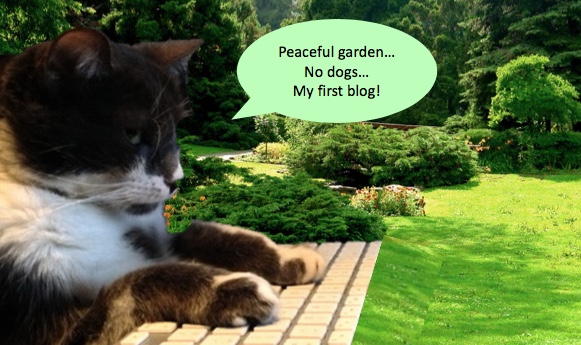
  12. Choose an image to accompany your story. To be clear about copyright, use Google Image search, click ‘Tools’, then  ‘Usage rights’, then ‘Labelled for reuse’. If you want to be creative, drag the image into a Powerpoint page and play around with it to make something creative. Then use Grab or a screen-capture app to turn your new image into a jpeg. 

We look forward to receiving your first submission. Please send it to yellowpoint2020@gmail.com.

Yes, even you, who is currently thinking “I could never write a blog!”

Every blog will be posted to our YES Facebook page, and the best will find a hallowed place on our website.

Featured

The YES Nature Photo Contest

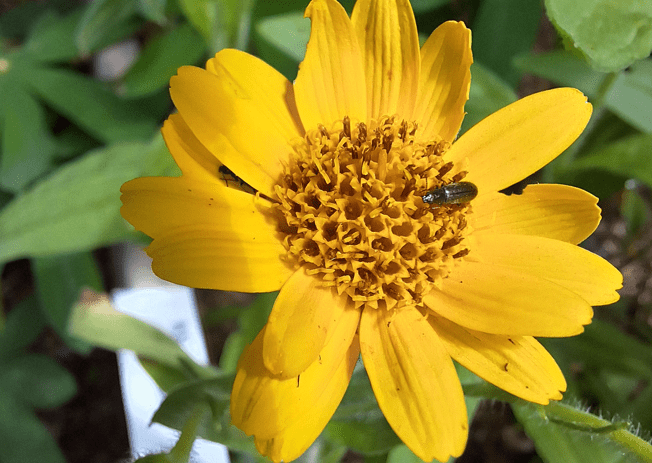
The Yellow Point Ecological Society is happy to announce the $250 Winner of our Nature Photo Contest: 

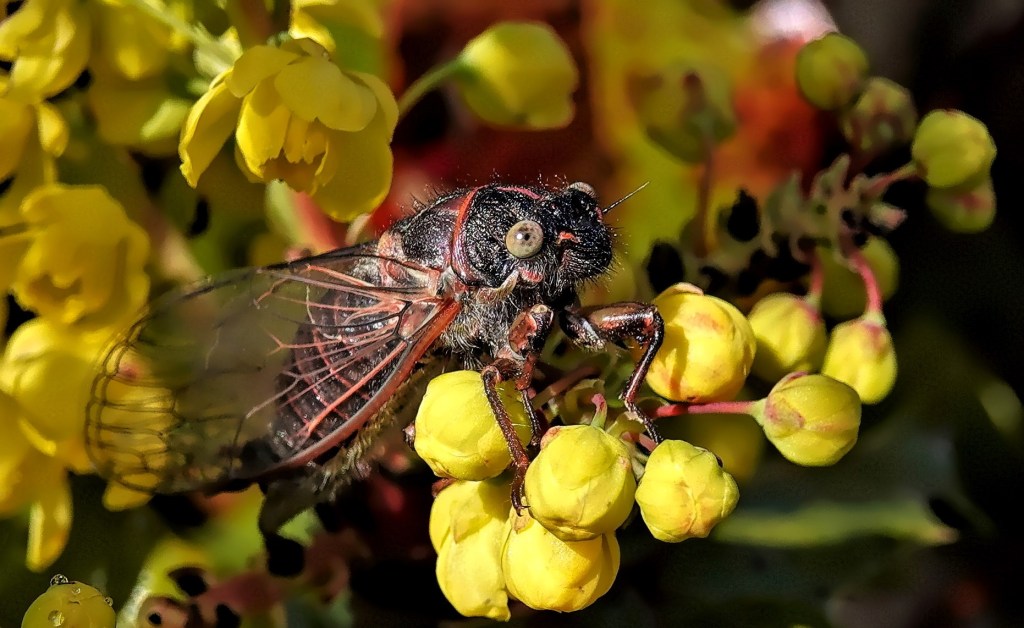
Lynda Stevens, for her gorgeous photo of a Salmonfly Cicada resting on an Oregon Grape flower.

Lynda lives in South Nanaimo, and she got seriously into amateur photography when she moved here from Nelson five years ago, starting with her love of birds then moving onto insects. 

She loves the parks and trails around Cedar and Yellow Point, and she took the photo in early spring close to the Coco Café in Cedar, at the start of the Morden Colliery Regional Trail, using an ordinary point-and-shoot camera – a Sony RX104 with a variable range lens. 

Congratulations, Lynda!

Featured

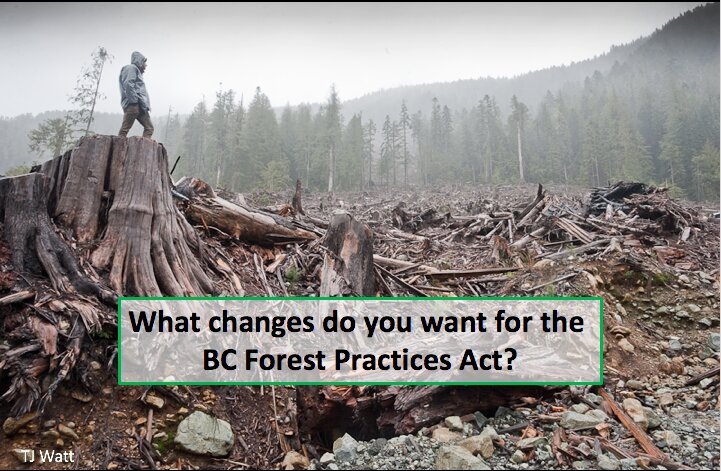
Some Suggested Changes to the Forest and Range Practices Act

Forest Practices Act

The BC Ministry of Forests is asking for our thoughts on how they should reform the Forest and Range Practices Act, with a deadline of Monday July 15th for comments.

https://engage.gov.bc.ca/govtogetherbc/consultation/forest-and-range-practices-act/

To help in your considerations these are our suggested changes, drawing on thoughts from the Sierra Club, the Ancient Forests Alliance, the Forest Practices Board, and others.

Because we live in a democracy:

Continue reading “Some Suggested Changes to the Forest and Range Practices Act”

Featured

An Opportunity to Build Homes in the Forest – with UPDATE

21 Acres Lane

Update:

This parcel of land has been sold in a way that makes us very happy. A German couple who have roots on the Island have bought the 21 Acres for the sole purpose of preserving the forest, and creating a partnership with Wildwood to practice ecoforestry on the land..

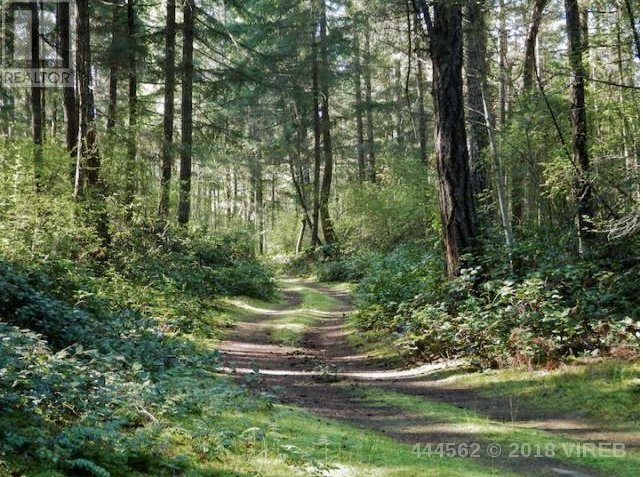
There’s a 21-acre parcel of forested land on the market in Yellow Point, at the end of Roper Road. Yellow Point is a jewel of a rural area that’s like a Gulf Island without the ferries, 20 minutes north of Ladysmith, 25 minutes south of Nanaimo.

The land has not been logged for years, and fifty years ago it was managed by Merv Wilkinson, of Wildwood fame. As Yellow Point residents, we would love to welcome new people to the area who share our appreciation and respect for the forest.


Featured

CVRD Area H Local Election, 2018

Our congratulations to Mary Marcotte,

on winning the election!

CVRD Area H

Our local election is this Saturday, October 20th. Who should you vote for in CVRD Area H? We assembled a Candidates’ Questionnaire on matters that concern us. Here are the candidates’ responses. Continue reading “CVRD Area H Local Election, 2018”

Featured

RDN Area A Local Election, 2018

Our congratulations to Keith Wilson,

on winning the election!

RDN Area A

Our local election is this Saturday, October 20th. Who should you vote for in Regional District of Nanaimo Area A? We have assembled a Candidates’ Questionnaire on matters that concern us. Here are the candidates’ responses.  Continue reading “RDN Area A Local Election, 2018”

Featured

Protecting the Coastal Douglas Fir Forest: Seven Practical Solutions

stock-photo-sun-rays-600x400

It cools us in the summer, it warms our hearts all year,

It provides a home for owls and flowers, for herons, cedars, fir.

It shapes the landscape, painting peace, away from the urban rush,

It protects our water all year round, surrendering it clear and fresh.

In Japanese, the word shinrin means forest and yoku means bath, so shinrin-yoku means ‘forest bath’: being immersed in the forest with all our senses. Listening to its quietness, seeing the variety of trees, mosses, lichens and rocks, tasting the air as you breathe in deeply, touching the rough Douglas fir and the smooth red arbutus, going barefoot across the earth, dipping your feet in a forest stream, lying down to gaze up at its beauty. Such bathing brings healing to the body, heart, mind and soul.

Quite Distressing

Continue reading “Protecting the Coastal Douglas Fir Forest: Seven Practical Solutions”

Featured

Poetry in the Forest

PoetryThese are the poems that we shared in the forest on a wonderful May morning full of wildflowers. Enjoy!

At Blackwater Pond

by Mary Oliver, a poet from Ohio, aged 82

At Blackwater Pond the tossed waters have settled after a night of rain.
I dip my cupped hands.
I drink a long time.
It tastes like stone, leaves, fire.
It falls cold into my body, waking the bones.
I hear them deep inside me, whispering …
Oh what is that beautiful thing that just happened?


That Patch of Wilderness

by Lacey Clark, a young woman who lives in a tiny home the Cowichan Valley

We are like that patch of wilderness
Though the streets are paved with concrete
I see the vibrant bursts of life push their way through the cracks
with unfaltering determination
Bold in their blatant disregard
At mans attempt to cover their wildness
Though I may shade my softness with downturned lashes
I too
Yearn to push through the cracks of my lids
To share the light of my sameness
To be recognized from under the concrete
Of my expression
As the brambles of the blackberry
I too
Can yield a thorny exterior
Vines of prickles may climb my words
An attempt to protect the sweet fruit that is
Myself
May the birds of truth steal the seeds
of my longing and spread them far
That I may grow
Diversely
Over the earth
I see you, the wilderness
Breathing deep under the city
Your time of hibernation almost up
I feel your listlessness.
Deep in my bones

Prayer of the Woods

By Veiga Simoes, a Portuguese writer, journalist, politician, diplomat and historian. While he was the Portuguese ambassador in Berlin, he signed visas that saved many Jews in World War II. This poem was written in May, 1914.

I am the heat of your hearth on the cold winter nights,
the friendly shade screening you from the summer sun,
and my fruits are refreshing draughts quenching your thirst as you journey on.

I am the beam that holds your house,
the board of your table, the bed on which you lie,
and the timber that builds your boat.

I am the handle of your hoe,
the door of your homestead,
the wood of your cradle,
and the shell of your coffin.

I am the bread of kindness and the flower of beauty.
Ye who pass by, listen to my prayer:
Harm me not.

My Heart Soars

by Chief Dan George, past chief of the Tsleil-Waututh (slay-wah-tooth) First Nation, an actor, poet and author.

The beauty of the trees, the softness of the air, the fragrance of the grass, speaks to me.

The summit of the mountain, the thunder of the sky, the rhythm of the sea, speaks to me.

The strength of the fire, the taste of salmon, the trail of the sun, and the life that never goes away, they speak to me.

And my heart soars.

Trees

By Alfred Joyce Kilmer, American poet. He wrote this poem in 1913; he was killed by a sniper’s bullet in July 1918, while serving in World War One, at the age of 31.

I think that I shall never see
A poem lovely as a tree.
A tree whose hungry mouth is pressed
Against the earth’s sweet flowing breast;
A tree that looks at God all day,
And lifts her leafy arms to pray;
A tree that may in Summer wear
A nest of robins in her hair;
Upon whose bosom snow has lain;
Who intimately lives with rain.
Poems are made by fools like me,
But only God can make a tree.

Something About A Forest

By Sophia White, 18 years old; she lives in the Appalachian Mountains in America

There’s just something about a forest
That makes the turbulent soul fall still
And listen to the mournful dirge
Of the solemn whipporwhill.

There’s just something about a forest
That makes closed eyes want to look
At the rippling, tippling kaleidescope
Of the steady-flowing brook.

There’s just something about a forest
Than makes the angry gazes see
The regal and majestic might
Ot the ancient maple tree.

There’s just something about a forest
That makes the most stubborn will learn
To praise the bashful beauty
Of the pale green, newborn fern.

There’s just something about a forest
That awakens weary souls
With the fresh rejuvenation
That only a forest holds.

The Cedar and Fir Tree Lovers

by Ray Lucero, an American poet

During a spring day walk through a primeval rain forest,
We encountered on a steep hillside two old growth trees,
One a Western Red Cedar the other a Douglas Fir.
Incredibly the two giants seemed joined together near ground level.
How could this be?
After all they were of two different species!

Our minds quickly filled with possibilities;
Were they just fused for mutual support?
Were they some kind of cross breed,
If so could they propagate?

We concluded that they were married.
“For better or worse, in sickness or in health”
Unheard wedding vows save for their tall fellows,
Standing silent witness.

We imagined their roots beneath ground,
Forever entwined in lifelong bliss.

We pondered what might happen when age and disease,
Toppled one of these magnificent lovers?
Would the other grieve?
Would the surviving lover stand witness…
As flora and fauna lay claim to the bountiful offering,
Of the fallen giant sacrificed to them?

Would the surviving lover wither and die or choose life?

We then realized that diversity, cooperation, and love are
Earthly traits celebrated by all living plants and animals.

We left the forest in awe and inspired by,
“The Cedar and Fir Tree Lovers”

How Can It Be Time?

By Doug Makaroff, an urban planner and developer who lives in Victoria. Doug founded the Elkington Living Forest Community, a forest ecological hamlet south of Shawnigan Lake, which saved 800 acres of forest by the use of residential clustering on 15% of the land.

How can it be time
for the acorns to bud already?
The summer’s only just begun
and not weeks since the precious
pale leaves of May emerged.
But now the next generation appears
small firm green expressions of fertility
held sunward by dappled waxen leaves
hardening against a backdrop of grizzled bark.
The grass beneath the trees
withers but is not dead.
The camas flower too will see another season.
This landscape unfolds in so many
stages of birth, life, decay, death combined.
Oh, that my heart could grasp and hold the
mystery of the self-addressed envelope of LIFE.

One final paragraph of advice

By Edward Abbey, an American author and essayist noted for his advocacy of environmental issues, his criticism of public land policies, and his anarchist political views. His best-known works include the novel The Monkey Wrench Gang, which has been cited as an inspiration by many environmental groups.

One final paragraph of advice: Do not burn yourselves out.
Be as I am – a reluctant enthusiast, a part-time crusader, a half-hearted fanatic.
Save the other half for yourselves and your lives for pleasure and adventure.

It is not enough to fight for the land; it is even more important to enjoy it.

While you can.

While it’s still here.

So get out there and hunt and fish and mess around with your friends, ramble out yonder and explore the forests, encounter the grizzly, climb the mountains, bag the peaks, run the rivers, breath deep of that yet sweet and lucid air, sit quietly for a while and contemplate the precious stillness, that lovely mysterious and awesome space.

Enjoy yourselves, keep your brain in your head and your head firmly attached to the body, the body active and alive, and I promise you this one sweet victory over our enemies, over those desk-bound people with their hearts in a safe deposit box and their eyes hypnotized by desk calculators.

I promise you this: you will out live the bastards.


We Heard No Owls

By Richard Arnold, an English prof at VIU, a great environmentalist and a fabulous man who died last year. He led many hikes up Mount Benson for the VIU community. Rachel Cooper, one of our Yellow Point Ecological Society members, says that this poem about the owls became real for her after Wyndlow’s logged 40 acres at the end of Doole Rd.

We did not hear a single owl this winter.
Our neighbor logged his hundred acres clean,
And now deep midnight wild has lost its splendor.

He claims that he’ll make pastureland to rent, or
Turn into trenches sprouting soybeans:
And we heard not a single owl this winter.

Trees gone, the man is not afraid to enter
Where once he heard weird cries and sweeping wings–
The place where midnight wild has lost its splendor.

Always the Great Horned whooped beyond our window,
Bass rhythmic mutters in our December dreams–
But we heard not a single owl this winter.

What fiend would scorch a gorgeous wood to cinders?
Quiet snows bereft of feathered hunters mean
That our deep midnight wild has lost its splendor.

He goes to church, yet God knows he’s a sinner;
The stars frown down on this diminished scene;
We did not hear a single owl this winter,
And now deep midnight wild has lost its splendor.


A Wolf in the Choir

by Richard Arnold

Although essentially I hated school,
I had one brilliant outlaw for a teacher.
“When it comes to truth, I’m lazy,” he used to say.
“I find it in close-by, ordinary things.”

The Literature he showed us was thunderclouds
Swollen like dark cheeks with a prodigious message
In the fearful moments of silence before they open
With tongues of fire to teach the listening earth.

In Economics he taught us the constant debit
Of forests and rivers, the credit of concrete and greenhouse.

Religion we learned by standing in April rain,
Hats off, in silence, seeing it soak the ground.

Politics, he claimed, would quickly go extinct
If we all simply heard the steady song
Our reason sang, then tuned our living to it.

In Music, he’d talk about the genius of Bach-
But weep for joy when he heard the evening grosbeak.

Our Sociology was dropping to hands and knees
On beaches to watch the yellow sand-verbena
Fling its fragrance of sex to pollinators.

The years passed on. At last we graduated.
We packed the hall, and our commencement speaker
Talked stagnantly about how noble Science
Was waiting for us to run its budgets of billions
And ride in rockets to learn the universe.

But afterward, shaking his head, our teacher took us
Aside and quietly gave us our last lesson.

“Science? The universe?
Ride a fifty-cent bus to the creek and study the eyes
Of a wolf-spider preparing to launch on a cricket.”

Then sidled away, hunch-shouldered, almost arachnoid,
Leaving us (our first moult finished) with fledgling fangs
To pierce and suck the truth in uncouth ways.

Leave it to Beavers

By Pamela Walker, Take 5 Magazine, November 2025

There are many strange facts about beavers that we Canadians should know just … because. No one has probably seen a nickel lately, but the nation’s animal has graced the coin since 1937.

Source: OpentextBC

Beavers are known mostly for their logging expertise. They can fell a 5” diameter tree in three minutes according to Frontenac News.
Continue reading “Leave it to Beavers”

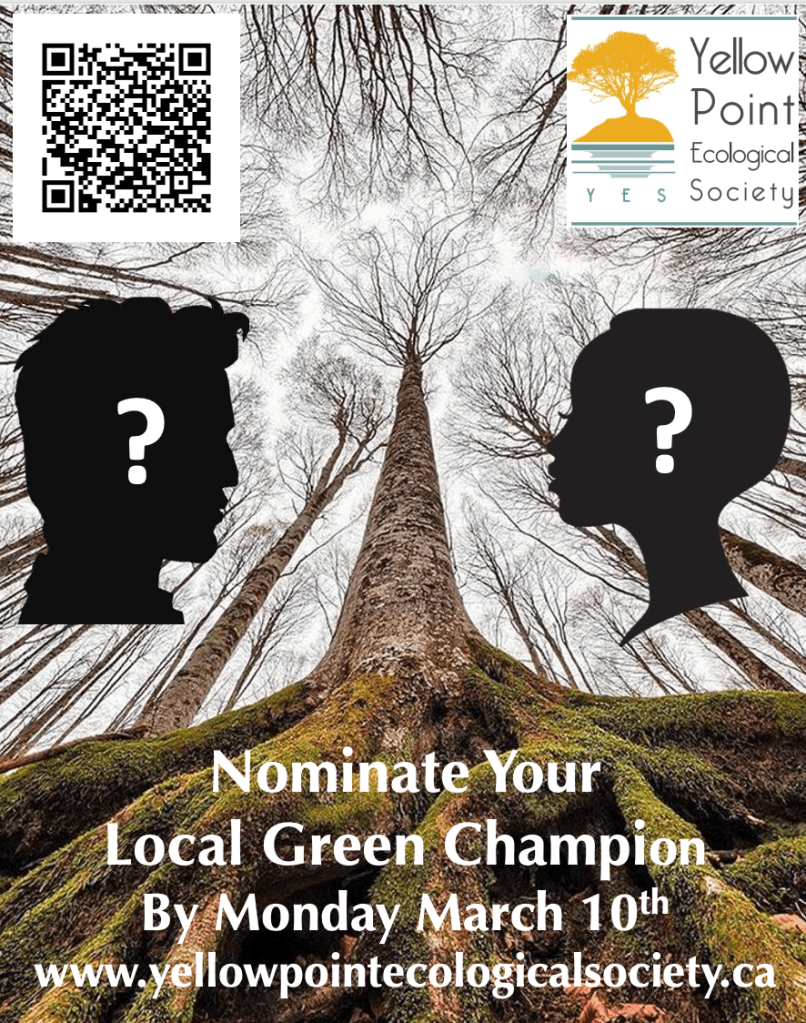
Who are our Local Green Champions? 

In partnership with Take 5 Magazine, we – the Yellow Point Ecological Society (YES) – are launching a quest to find our Green Champions, and give them the recognition they deserve in the April issue of Take 5.

If you know someone who deserves recognition, please nominate them. Send a 250 words description of their work to yellowpoint2020@gmail.com, along with their name, address, phone, email, and their willingness to be nominated, by Monday March 10th, 2025 (midnight

Our boundaries are the Take 5 readership area, from Crofton in the south to Cable Bay and Jack Point in the north, from the ocean in the east to the mountains in the west. As for Duncan, Nanaimo, and Gabriola – we encourage you to organize your own Green Champions awards!

If there are published stories that reference their work, so much the better – please include the links. If you want to nominate your husband, son, or step-niece twice removed by your second marriage, best find someone else to nominate them. If two or three of you want to nominate someone together, so much the better. 

Do you know a teacher, professor, or school board trustee who goes out of their way to share their love of nature with their students?

Do you know perhaps a local business owner who makes a special effort to minimize waste, avoid harmful emissions, and make a difference on the Earth?

Is there a planner, engineer, city councillor, or Regional Director who you know to be a champion for nature? Perhaps even a Mayor?

Maybe you know an Indigenous person or elder who understands the importance of our connection with nature, and goes out of their way to share their knowledge.

Maybe there’s a volunteer who loves a particular place that is threatened with harm, perhaps due to real estate development or logging, and is working to save it.

Or is there someone who works with children, getting them out into the woods, getting them familiar with the mosses, lichens, and caterpillars, the worms and bugs who live in the soil, the trees and plants, and the birds with whom we share our home?

Maybe you know a farmer who cares about nature on the farm, who goes out of their way to protect nesting birds, to set aside special areas, and grow food without spreading toxic chemicals on the land.

Maybe you know someone who protects nature silently as an investor, avoiding companies that harm nature and investing instead in ventures that restore and protect nature and the climate.

Maybe there’s an author, a children’s book writer, a singer, artist, or a magician who uses their skill to weave inspirational magic and make people fall in love with nature. 

Or maybe you know a scientist who is working to help us better understand the climate crisis, the biodiversity crisis, or the mysteries of plant consciousness. 

And maybe there’s a fisher or a marine biologist who treasures the ocean, who goes out of their way to keep the plastic trash and fishing gear out of the sea.

The judging panel will be the Board of YES, so none of us or our immediate family can be nominated. Sorry, Uncle Jim! The award will be a feature in April issue of Take 5, and a mystery recognition yet to be revealed. Instead of April Fool’s Day, it will be Nature’s Jewels Day. If there’s a business that would like to sponsor this yet-to-be-revealed ceremony, please let us know.

The deadline for nominations is Monday March 10th.

Send them to yellowpoint2020@gmail.com. Thankyou!

The small print:

The Directors of YES are not eligible to be nominated.

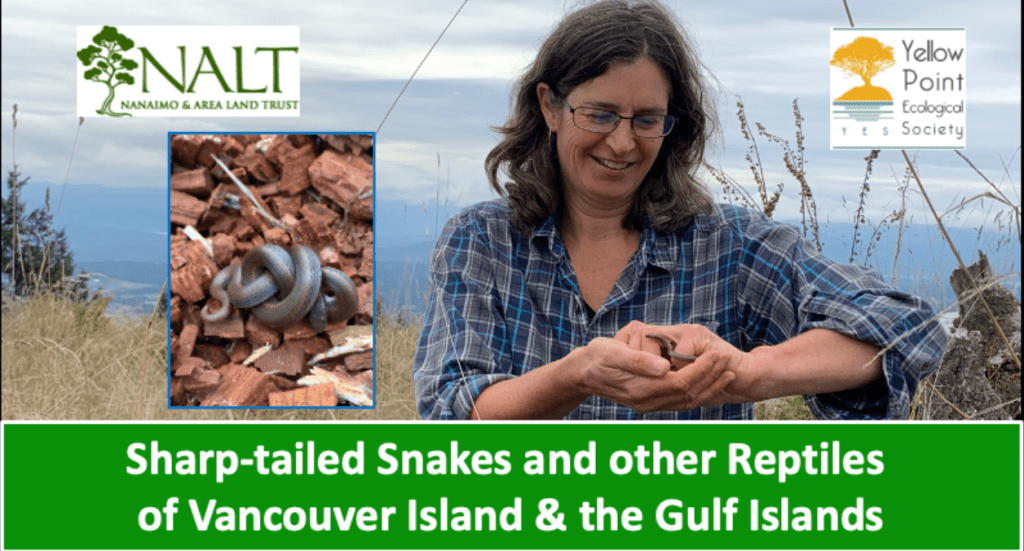
Sharp-Tailed Snakes and Other Reptiles

Here is the video from  Carrina Maslovat’s and Laura Matthias’ presentation https://youtu.be/H7_HeeEQlLE. If you have an area of sun-filled Garry oak meadow on your land, and are interested to set up artificial cover object (black asphalt shingle) to observe if you have these tiny snakes (see below) on your land, please contact Linda Brooymans at the Nanaimo area Land Trust. stewardship@nalt.bc.ca  The video explains all about it.

Water Solutions in Yellow Point and Cedar

In December 2023 YES hosted a packed house at North Oyster Community Hall for our evening on Water Solutions for Yellow Point and Cedar.

Here are the speakers’ slides:

Sylvia Barosso – YES to Water Solutions: Understanding and Protecting Groundwater. Click HERE

Jack Anderson – Improving Sustainable Water Options. Click HERE

Quentin Goodbody –

Welcome to the YES BioBlitz 2025

You can sign up here  YESBioBlitz2025 under the community menu.  

(Log in to iNaturalist. )

Why join?

This is such important citizen science, which supports research and helps policy makers protect nature.  Check out how your data makes a difference here. It is also a great opportunity to develop a local community of people who understand and care for nature.

When?

Practice starts now!  This event lines up with the City Nature Challenge across Canada:

April 25th – April 28th Take pictures of wild fungi, plants and animals.

April 29th– May 4th  Upload and identify the species in iNaturalist.

Results will be announced by May 15th.

With whom?

You can do this on your own, with your outdoor class, or with others who you can teach or learn from.  You already have a friendly community of online iNaturalists who are so helpful at this time of year.  Join us at:

  • Saturday April 26th, 10am: Holland Creek Trail walk led by Jen Moss of Friends of Holland Creek.  Meet at the Holland Creek trailhead on Dogwood Drive.
  • Sunday April 27th, 10am: Cable Bay Trail walk led by Jain Alcock-White of Champagne Hill Botanicals.  Meet at the Cable Bay trailhead on Nicola Rd.

What you need – and it’s all free!

All you need to participate in the BioBlitz are:

An iNaturalist account or app, which is free.

A smart phone or camera to capture images or sounds.

A smart phone or computer to upload your images or sounds.

You can use the iNaturalist App or the webpage iNaturalist.ca.

Where to go?

The area for this year’s YES Bioblitz is the same as 2024.  It includes Ladysmith, South Nanaimo, Cassidy, and our coastal waters to the east – see map below.  There are many public parks where you can explore, and there are reserves and private lands where you need permission. NOTE: We do not have permission to enter the Woodley Range Ecological Reserve.

Only photos and sound recordings taken during the designated dates and times (6am on April 25th to 8pm on April 28th) in this geographical location will count towards our YES BioBlitz. Of course, everything entered in iNaturalist, year-round and in other places, is still valuable.  

How?

Check out the resources and links below and note the top tips:

  • Take good pictures – focus properly, fill the frame or crop the picture, take different views.
  • Fill the gaps in local knowledge – go to places or look for species others tend to overlook.
  • Make your data shareable – make sure the location is recorded,  and check that your license settings allows the data to be used.  iNaturalist recommends using CC0, CC BY or CC BY-NC.  Licenses are located under the account settings, in contents and display.

Participate as a school group

There are many great resources on iNaturalist and the Internet on how to participate as a school group, how to take photos that can be identified, and how to use iNaturalist. In some cases you should use Seek, which is a simpler app with more privacy controls, just as educational.  

If you have questions, message us in iNaturalist or email us at yesbioblitz@gmail.com.  If you want to chat, let us have your phone number and we will call back. 

Useful links

Past bioblitzes

How to guides

Other projects in our area!

Protecting Communities and Nature with a New Forest Act

First published in Take 5, September 2024

One winter afternoon in 2021, after a big winter storm, Carolyn and I were enjoying some time off at Cowichan Bay. As we strolled down the dock, expecting to see the sea-lions, we saw instead something that astonished us. The entire sea had turned brown – murky brown. The sea-lions had fled, along with any transient sailors. The fish and ducks had surely fled too. “It happens every year”, we were told. 

Continue reading “Protecting Communities and Nature with a New Forest Act”

The 2024 YES Bioblitz

Welcome to the 2024 YES BioBlitz

You can sign up here  YESBioBlitz2024 under the community menu.  First, you have to register or log-in. It’s all free.

This is such important citizen science, which supports research and policy maker to protect our environment.  More and more studies and projects are using this open-source information.  It is also a great opportunity to develop a local community of people who understand and care for the environment.

April 26th – April 29th Take pictures of wild fungi, plants and animals.

April 30th– May 5th  Upload and identify the species in iNaturalist.

Results will be announced by May 15th and prizes chosen by the end of May.

New this year – we are planning a group walk in Cable bay area and in support of the Cable Bay Trail fund raising.  Sign up here and meet up at Cable Bay trailhead on Nicola Rd at 10 am, Saturday April 27th.

All you need to participate in the BioBlitz are: 

  1. An iNaturalist account or app, which is free.
  2. A smart phone or camera to capture the images or sounds.
  3. A smart phone or computer to upload the images or sounds.

You can use the iNaturalist App or the webpage iNaturalist.ca.

The area for the Bioblitz is the same as 2023. It includes Ladysmith, South Nanaimo, Cassidy, and our coastal waters to the east – see map below.  There are many public parks where you can explore, and there are reserves and private lands, where you need permission. NOTE: We do not have permission to enter the Woodley Range Ecological Reserve.

Only photos and sound recordings taken during the designated dates and times (6 AM on April 26thto 8 PM on April 29th) in our chosen geographical location will count towards our YES BioBlitz. Of course, everything entered in iNaturalist, year-round and in other places, is still valuable.

This year’s prizes will be a selection of nature books and cards.

Participate as a school group

There are many great resources on iNaturalist and on the internet on how to participate as a school group, how to take photos that can be identified, and how to use iNaturalist.  

If you have questions please message us in iNaturalist or email us at yesbioblitz@gmail.com.  If you want to chat, let us have your phone number and we will call back. 

Useful links

Checkout other projects in our area!

The YES BioBlitz 2023 Report

by Nikki Toxopeus

The results are in, the stats are done, and the prizes awarded!

The Yellow Point Ecological Society BioBlitz for 2023 is officially over! Thank you to all our participants and identifiers for making it so much fun and so successful.

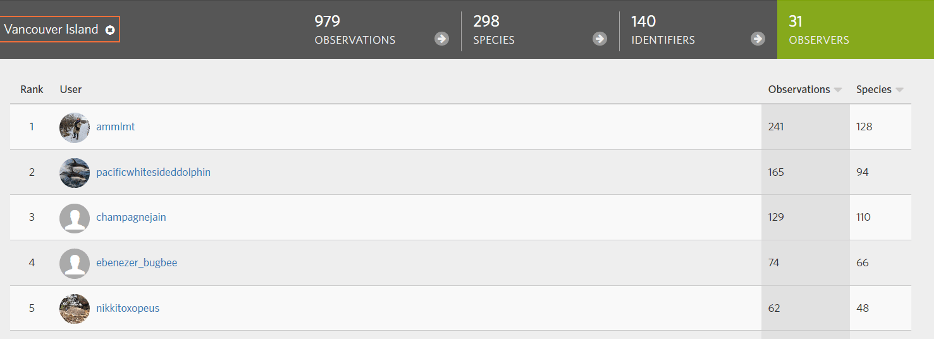
We clocked up a similar number of species as previous years, with fewer observers.  We had 298 research grade species as shown below, thanks to the quality of the observations and the support of the wider iNaturalist community helping ID the entries.

YES board members are not eligible for prizes, and so our prize winners are Annette Lefaivre (visiting from Calgary and helped map the area), Liam Steele (from Ladysmith and an outstanding young naturalist) and Heath Bleau (who recently moved, with his wife Kathy, to Nanaimo). Annette and Heath received a set of 10 Briony Penn Nature cards, and Liam was persuaded to accept a BC Museum Mushroom book, in part as a thank you for all his work helping to ID species.

We also awarded a school prize to the Grade 3 class at the Stz’Uminus Community School, who joined the BioBlitz for the first time and will be presented with a set of the Pacific North West Plant Knowledge Cards and a set of Briony Penn’s Nature posters.

Our results compared to last two years (given in brackets) are as follows:

Observations 1847 (2004, 2289)
Species 538 (556, 508)
Identifiers 165 (178, 252)
Observers 38 (47, 62)

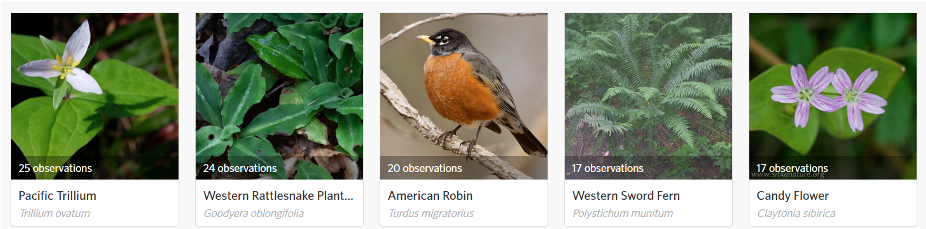
This year, the most observed species were


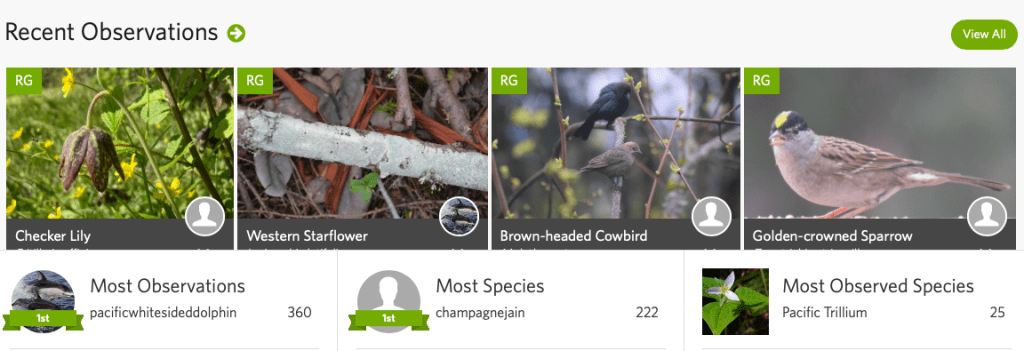
Pacific Trillium (Trillium ovatum) was the most observed and by the most people.
Western Rattlesnake Plantain (Goodyera oblongifolia) was spotted multiple times by a few people.
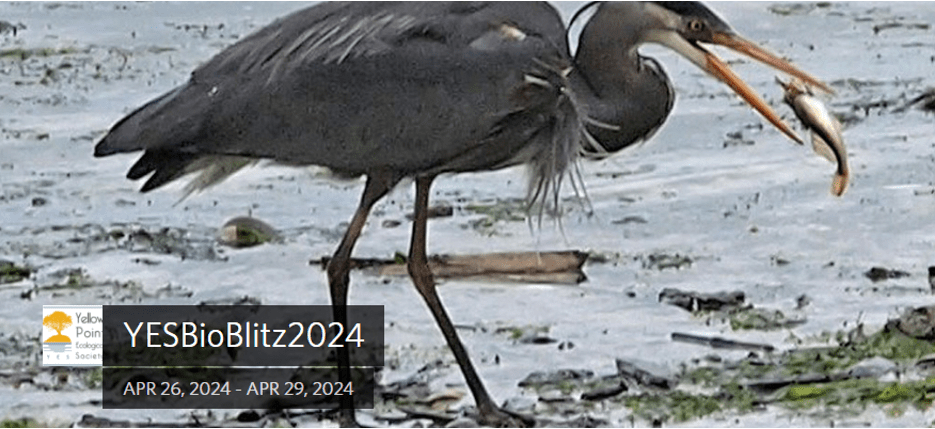
The Great Blue Heron (Ardea herodias) was the top observed species last year and no one recorded it this year.

Other notable differences were that there were only 4 sightings of the Bald Eagle (Haliaeetus leucocephalus), Devil’s club (Oplopanax horridus) was absent this year, and western meadow rue (Thalictrum occidentale) was seldom seen. 

The most observed species aligns with my experience of this season – the trilliums were out in force, the robins were furiously nesting and dominating the dawn chorus, and I did not see the Great Blue Heron by the Ladysmith Marina (but they are back now).

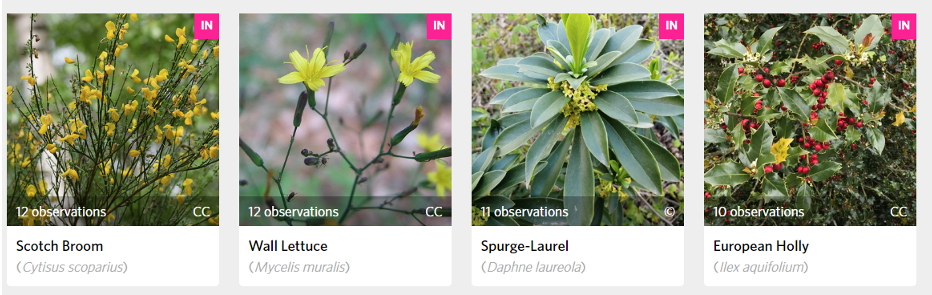
The top introduced and invasive species recorded remain:
Scotch Broom (Cytisus scoparius) – located along Cable Bay Trail, in Joan point Park, Holland Creek Park, Holland Creek Estuary Trail, Haslam Creek, near yellow Point Lodge and along power line ROWs.  Broom cuts are planned for some of these locations.
European Holly (Ilex aquifolium) – located in Stocking Creek Park, Holland Creek Park, Morden Colliery, Kinsman Park, Estuary Trail, and other roadsides
Spurge-laurel (Daphne laureola) – all the above parks!!

I will be using and adding to this data set to help determine where we need to remove invasives from our parks and other special areas.

There was some great teaching and learning happening in the online chatter. Next year let’s expand the learning to the field, organise some group walks and take the iNater chatter to the field.

See you same time, same place next year!  Reserve April 26-29th 2024 for getting out in nature with your friends, family, and other naturalists. This date aligns with the global City Nature Challenge BioBlitz and we hope Nanaimo and other Vancouver Island Cities will join in again.

Many thanks! – Nikki Toxopeus

The YES BioBlitz 2023

Friday April 28th to Monday May 1st

Welcome to the 2023 YES BioBlitz!

A BioBlitz is when ordinary folks wander out into the local woods and wetlands, looking for as many different species of plant, animal, bird and fungus as we can, and take a photo, using the iNaturalist app. When lots of us to it over a short period, it gives us a snap-shot of how Nature is doing.

Please encourage people to participate! There’s a poster here that you can print, and put up in your local area. Keep on reading, below!

Friday April 28th – Monday May 1st   – take pictures of wild fungi, plants and animals

Tuesday May 2nd – Sunday May 7th  – upload and identify the species in iNaturalist

Results will be announced by May 14th and prizes chosen by the end of May.

To participate in the BioBlitz, you need: 

  1. A free I-Naturalist account or app;
  2. A smart phone or camera to capture images or sounds;
  3. A smart phone or computer to upload images or sounds

 4. Go to YES BioBlitz 2023 (it does not work using Safari). Create an account, or log in if you have one.

5. Top right, click “Join”

6. If you still have questions, message us in iNaturalist or email us at yesbioblitz@gmail.com.  If you want to chat, leave your number and we will call back.

The area for the Bioblitz includes Ladysmith, South Nanaimo, Cassidy, and our coastal waters to the east as shown on the map below.  We are looking at adding more area south of this and will update the site if successful.  Note there are many public parks where you can explore and there are reserves and private lands, where you need permission.

All photos and recordings taken during the designated dates and times (6 AM on April 28th to 8 PM on May 1st) in our geographical location will count towards our YES BioBlitz. Of course everything entered in I-Naturalist outside this time-frame is also valuable!

This year’s prizes will be sets of 10 nature cards by the Salt Spring naturalist and artist Briony Penn.

There are great resources on iNaturalist on how to participate as a school group, how to take photos which can be identified, and how to use iNaturalist.

Other projects in our area